
SelectZero release 2026.8
SelectZero 2026.8 is centred on access control and lineage. Roles now behave the way regulated environments expect them to, with visibility scoped down to the individual database and schema, and directory groups can drive role membership directly. Lineage becomes substantially more complete for calculated and aggregated columns. Around those, the AI assistant, alerting and the dbt integration each gain flexibility.
Self-directed lineage and relations through calculations
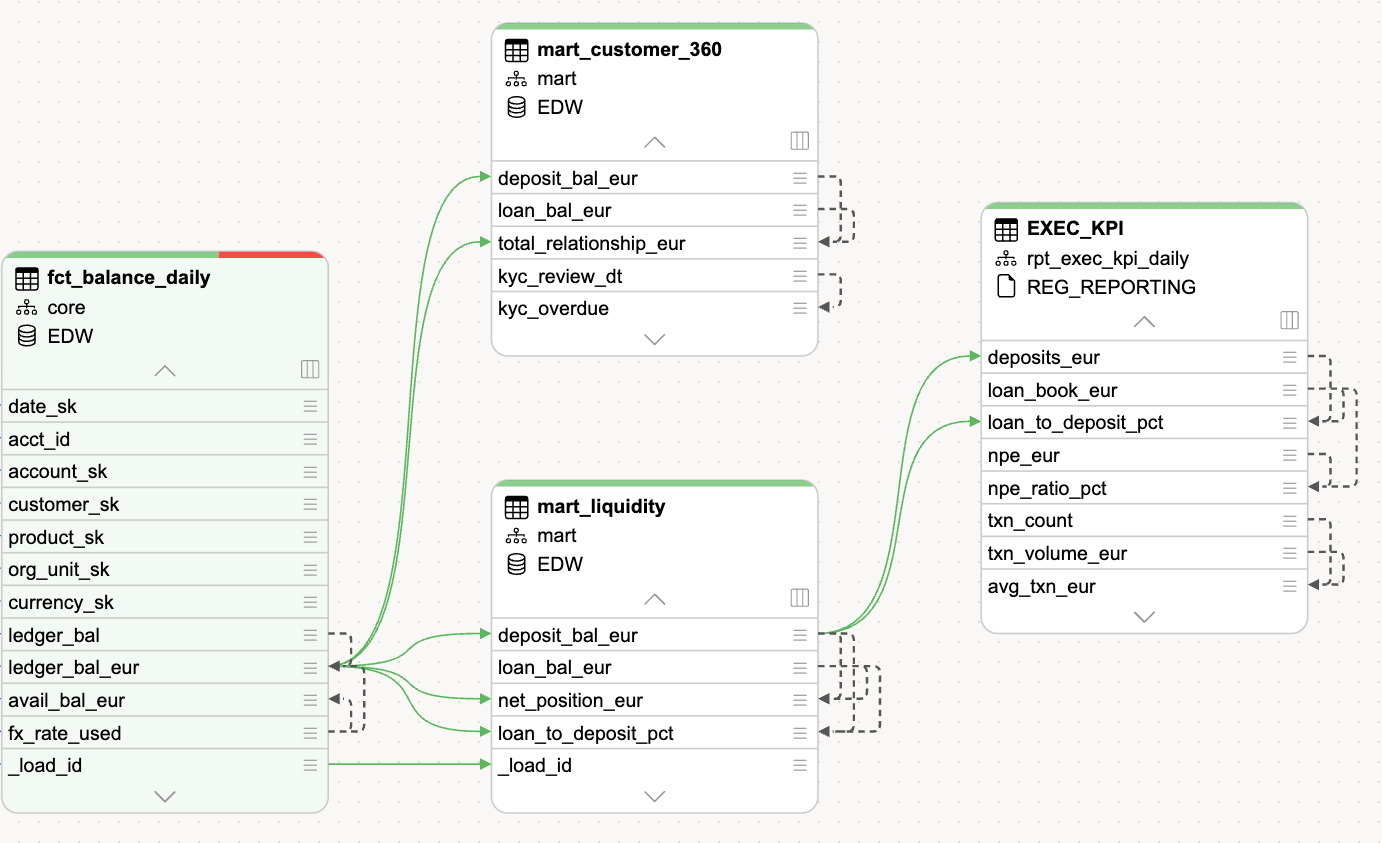
Lineage can now connect two columns of the same table or view, for example a total derived from its sibling columns or a self join, shown as brackets inside the object’s node in the graph. Calculated columns are also covered: when a result column is built with SUM, arithmetic, ROUND, COALESCE or CASE, every input column is linked to that one output column, where previously such expressions produced no lineage at all.
Role privileges scoped to each role’s own connections
A privilege granted by a role now applies only to the connections that the same role allows. Previously a user with a read-only role on one database and an editing role on another could edit on both. That combination no longer grants extra rights, and profiling results, sample data and test results are restricted the same way.
Schema-level access restrictions in connection settings
Each schema within a connection can now be limited to selected roles. A role without access to a schema does not see it in the catalog, in profiling or when generating tests.
Directory group mapping for SSO logins
Until now single sign-on, whether AD/LDAP or OAuth providers such as Entra ID, could only assign one default role to every user who logged in. Directory groups can now be mapped to existing SelectZero roles, so a user’s access is derived from their group membership rather than set by hand after first login.
Breached records included in test-case alerts
Alerts for a single test case can now include the list of rows that failed the check, not just the count. Previously that list was only available in test suite reports.
AI assistant supports Anthropic and Google Gemini
The AI assistant, which drafts test-case suggestions and catalog descriptions, can now run on Anthropic or Google Gemini alongside OpenAI, Azure OpenAI and Ollama. Both are selected as the API type in Settings and authenticate with an API key.

Release 2026.8
SelectZero release 2026.8 SelectZero 2026.8 is centred on access control and lineage. Roles now behave the way regulated environments expect them to, with visibility scoped down to the individual database and schema, [...]
Release 2026.7
SelectZero release 2026.7 SelectZero 2026.7 is one of the broadest releases so far, reaching nearly every part of the platform. The interface has been rebuilt end to end, and profiling takes a [...]

Unified data quality, catalog, and lineage: why G2 ranks SelectZero a High Performer
Most organizations don't have a data quality problem in just one system, they have one spread across ten different databases, dashboards, and pipelines that nobody fully understands anymore. SelectZero exists to close that gap: [...]
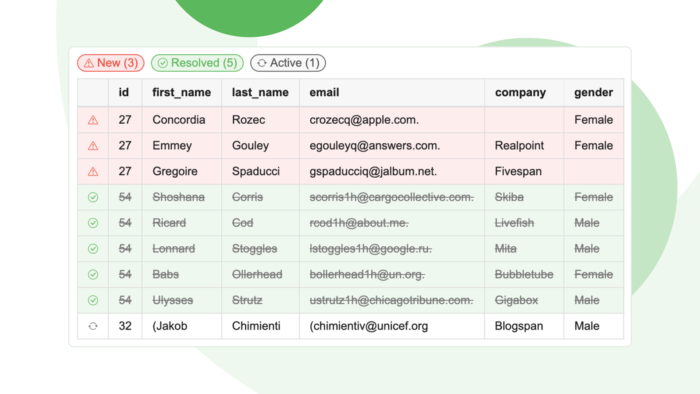
Did that fix actually work? Track row-level differences for data quality checks
When you monitor data quality, finding out that something is wrong is only the beginning. The harder question is what is wrong. Is this a brand-new problem that appeared overnight or a recurring issue [...]
SelectZero now integrates with dbt
SelectZero now ingests metadata from both dbt Core and dbt Cloud. Your dbt models, sources, seeds, snapshots, tests, and lineage flow into the SelectZero catalog and merge with metadata from every other system you [...]
Your catalog, in any AI client: SelectZero MCP server
SelectZero now ships a built-in Model Context Protocol (MCP) server. Point Claude Desktop, Cursor, Claude Code, VS Code, or any other MCP-aware client at your SelectZero instance, and your AI assistant gets first-class access [...]